For the past month, this series walked through one project: a 50,000 sqm parcel in Saudi Arabia, taken from a highest and best use question all the way to a net investor IRR. Area statement, cost stack, financing structure, pre-sales engine, two P&L engines, three IRRs and a waterfall.
Here is what I did not say along the way: every article was a module of something I have been building for the past year.
On 20 August, it opens for trial accounts. The FMP Modeling Hub, and the first platform on it: REFM, Real Estate Financial Modeling, at app.financialmodelerpro.com.
The Modeling Hub, and what is on it
The Modeling Hub is the home for structured financial modeling platforms. REFM is the first one, and it is the one opening on 20 August. Others will follow, built on the same principle: the discipline of a properly structured model, made accessible without rebuilding it from a blank sheet every time.
REFM exists because of every bloated template I have ever been handed. The 40,000-row input tabs. The IDC plugs that expired silently. The revenue lines that confused collections with recognition. Twelve years of KSA and GCC transactions taught me exactly what a defensible model needs, and I have spent the past year building that discipline into software.
How REFM works
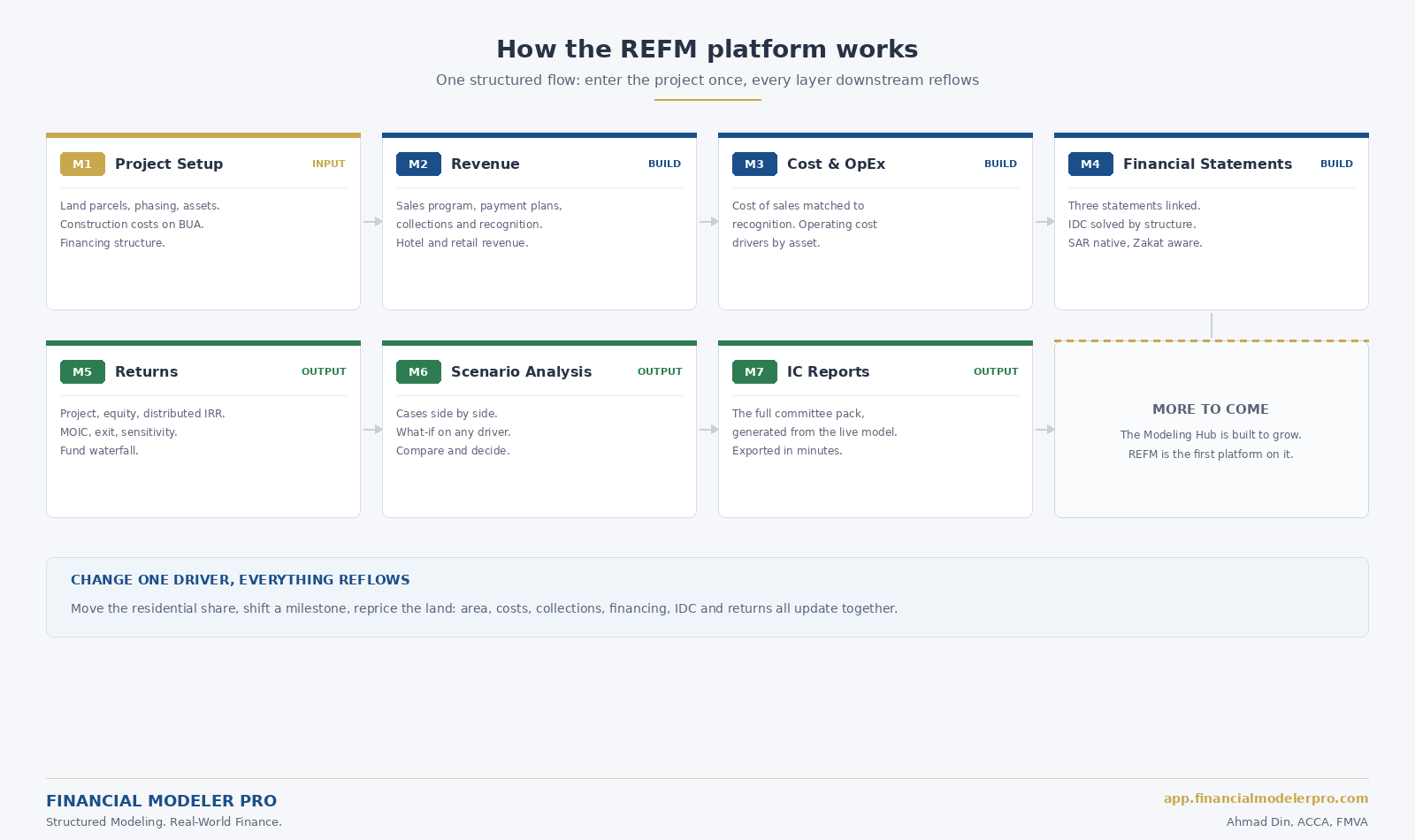
The platform runs as one structured flow. You enter the project once, and every layer downstream inherits from it.
M1 · Project Setup
The foundation layer, and the biggest one. Land parcels, FAR, phasing, and the area statement that allocates GFA across sell, operate and lease. Then the development costs: hard costs on built-up area by asset type, soft costs, contingency, developer fee, and land as cash or in-kind. And the financing structure: gross funding sized down to net by the collections curve, with drawdown in the order the facility actually specifies.
M2 · Revenue
The sales program: units, pricing, velocity, and the off-plan split. Payment plans mapped to construction milestones. Sold, collected and recognized carried as three separate curves, with the unearned revenue balance reconciling cash to P&L. And alongside them, the operating revenue engines: hotel occupancy ramp, ADR and seasonality; retail GLA, rent and escalations.
M3 · Cost and OpEx
Cost of sales matched to recognized revenue rather than to collections, so the development margin holds steady in every period. And on the operating side, cost drivers that flex with occupancy instead of a flat percentage of revenue.
M4 · Financial Statements
A full three-statement structure, linked. The IDC loop solved by structure rather than by a plug, whether interest is rolled up or paid in cash, with every charge visible period by period. SAR native. Zakat aware.
M5 · Returns
Project IRR, equity IRR and distributed IRR. MOIC. The exit on stabilized income. Sensitivity analysis. And the fund waterfall, management fee, preferred return, and carry, so gross and net investor returns are both visible.
M6 · Scenario Analysis
Cases built and compared side by side. Change the allocation, the pricing, the programme, the financing, and see what each scenario does to the returns. This is the highest and best use test from the second article in this series, run properly.
M7 · IC Reports
The part no article in this series covered: the full investment committee pack, generated from the live model. Summary, returns table, sensitivity grid, capital stack. Exported in minutes. The presentation layer that the very first article in this series said every model deserves.
And more to come. The Modeling Hub is built to grow, and REFM is the first platform on it.
The part that matters most
Change one driver and everything reflows. Move the residential share from 60% to 50%, and the sellable area, the sales program, the cost mix, the funding requirement, the IDC and the returns all update together. Shift a construction milestone, and the collections curve moves with it, and the financing follows. That is the difference between answering the investment committee in the room and promising to come back next week.
Built for KSA, specifically
This is not a global template with the currency symbol changed. SAR is native. Zakat is understood. Pre-sales mechanics reflect how off-plan actually collects and recognizes here. To my knowledge, nothing else combines development-stage modeling, a full three-statement structure, and KSA localization in a single self-serve browser tool.
Opens 20 August
REFM opens for trial accounts on 20 August at app.financialmodelerpro.com. Mark the date.
If you want to be among the first in, or want me to walk you through your own project when it opens, message me on LinkedIn. I am personally onboarding early users, because your feedback in these first weeks decides what gets built next.
To everyone who read, commented, shared, and messaged over the past month: thank you. This series was the tour. The doors open on 20 August.
Ahmad Din, ACCA, FMVA is a corporate finance professional with twelve years of transaction experience across KSA and the GCC, and the founder of Financial Modeler Pro.