In the previous article, our 50,000 sqm parcel produced 125,000 sqm of revenue-earning GFA, allocated across residential, hotel, and retail. This article builds the cost side on top of that area statement.
The construction cost plan is where a feasibility model earns or loses the trust of a quantity surveyor, a lender, and an IC all at once. Each of those audiences reads the cost stack differently, and each will find a different weakness if the structure is loose.
The first rule: costs apply to built-up area, not GFA
GFA is a planning number. It measures the area the regulations allow you to earn from. Built-up area is a construction number. It measures everything you actually build, and it is always larger.
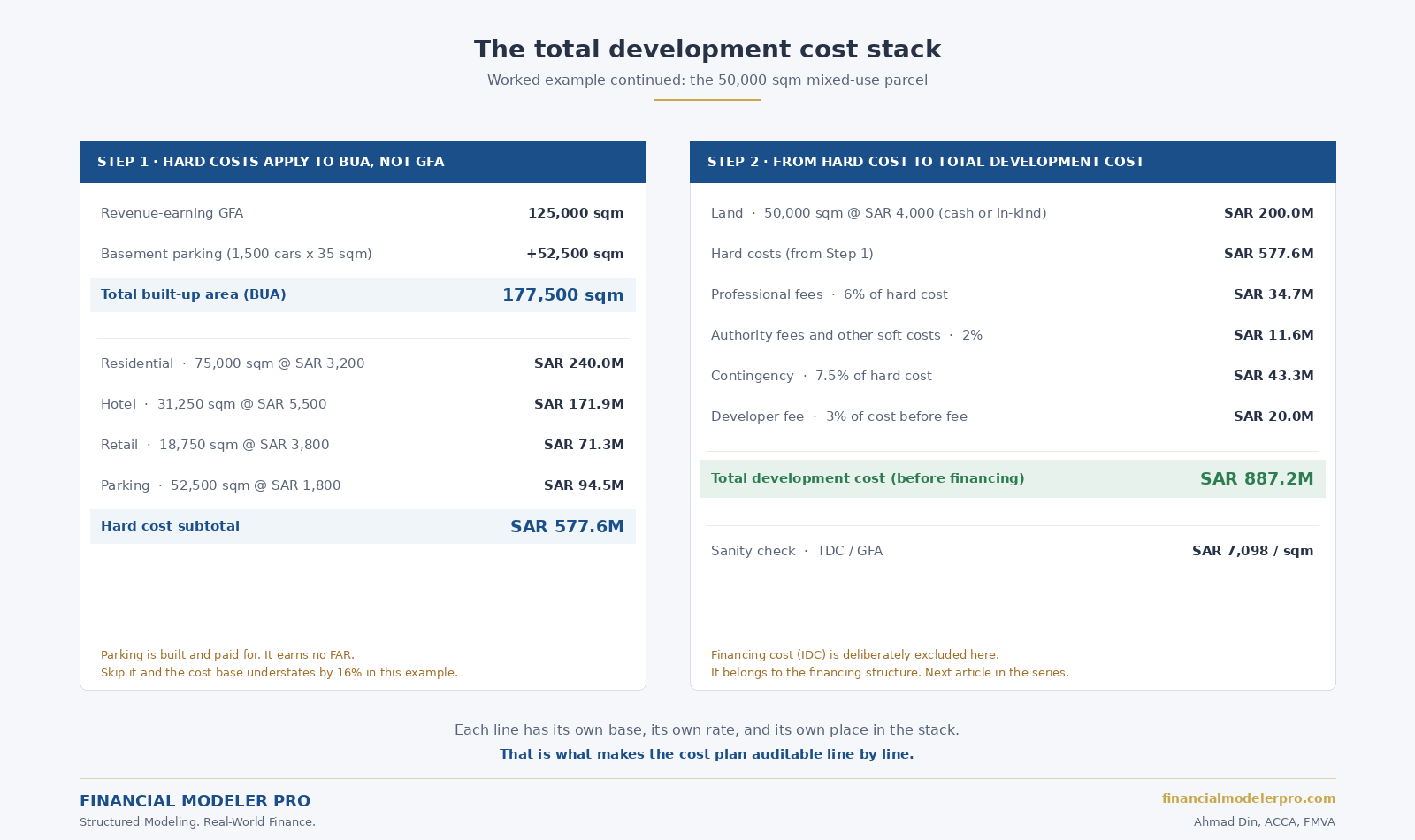
The biggest gap between the two is parking. In our example, the project needs roughly 1,500 parking bays. At 35 sqm per bay including circulation, that is 52,500 sqm of basement construction. Add it to the 125,000 sqm of GFA and the total built-up area is 177,500 sqm.
Parking is designed, excavated, waterproofed, ventilated, and constructed. It costs real money. It earns no FAR. A cost plan that applies construction rates to GFA instead of BUA understates the cost base by 16% in this example. That gap does not disappear. It surfaces during construction, when the budget is already committed and the financing is already sized.
Hard costs: by asset type, at its own rate
Different asset types cost different amounts to build. A hotel shell carries MEP intensity, fit-out standards, and back-of-house requirements that a residential tower does not. Retail carries its own structural spans and frontage requirements. Basement parking is the cheapest per sqm but has excavation and waterproofing dynamics of its own.
In the worked example, using illustrative KSA rates:
- Residential: 75,000 sqm at SAR 3,200 per sqm = SAR 240.0M
- Hotel: 31,250 sqm at SAR 5,500 per sqm = SAR 171.9M
- Retail: 18,750 sqm at SAR 3,800 per sqm = SAR 71.3M
- Parking: 52,500 sqm at SAR 1,800 per sqm = SAR 94.5M
Hard cost subtotal: SAR 577.6M. One blended rate across the whole project would hide the mix, and the mix is exactly what changes when the allocation changes. Rate-by-asset-type is what lets the cost plan reflow when the area statement moves.
Soft costs: each on its own base
Soft costs are not one line. They are several lines with different drivers, and the discipline is giving each its own base:
Professional fees, design, engineering, and supervision, are conventionally a percentage of hard cost. In the example, 6% of SAR 577.6M = SAR 34.7M.
Authority fees, permits, and other soft costs run separately. Some scale with built-up area, some are fixed. In the example, roughly 2% = SAR 11.6M.
Marketing and sales costs belong to the revenue side of the model, tied to the sales program, not to the construction stack. Keeping them out of the construction plan keeps both sides clean.
Contingency: a stated base and a stated logic
Contingency exists because construction carries risk that design maturity has not yet resolved. The modeling discipline is to state it explicitly: what percentage, on what base, and what it covers.
In the example: 7.5% of hard cost = SAR 43.3M. Early-stage feasibility carries higher contingency; a tendered project with a signed contract carries less. The IC will ask what the number covers and when it gets released back. A visible line with a stated base answers both questions before they are asked.
Developer fee: stated, not buried
The developer fee compensates the development manager for running the project. Convention is a percentage of total cost before the fee itself. In the example, 3% on the stack of hard, soft, and contingency = SAR 20.0M.
Where this matters most is in joint ventures and fund structures: the fee is income to the developer and a cost to the project, and the two perspectives must reconcile. A buried fee inside a blended cost line makes that reconciliation impossible.
Land: cash or in-kind, same cost, different capital structure
Our parcel is 50,000 sqm. At an illustrative SAR 4,000 per sqm, land cost is SAR 200M. The cost is the same whether the developer buys the land in cash or a landowner contributes it into the venture.
What changes is the capital structure. Cash land is a use of funds that must be financed. In-kind land enters as an equity contribution: the landowner becomes a partner, credited with SAR 200M of equity, and the cash requirement of the project drops accordingly. The total development cost is identical in both cases. The sources of funds, the equity splits, and ultimately the returns per partner are not.
A structured model holds land as a cost line with a funding flag, so switching between the two scenarios is one input, not a rebuild.
The worked example: the full stack
Putting it together:
- Land: SAR 200.0M
- Hard costs: SAR 577.6M
- Professional fees: SAR 34.7M
- Authority and other soft costs: SAR 11.6M
- Contingency: SAR 43.3M
- Developer fee: SAR 20.0M
Total development cost before financing: SAR 887.2M.
A useful sanity check: TDC divided by GFA = roughly SAR 7,100 per sqm. Experienced developers and lenders carry benchmark ranges for this ratio by project type and city. If your all-in cost per sqm sits far outside the familiar range, either the project is unusual or the model has a problem, and it is worth knowing which before the IC asks.
What is deliberately missing: financing cost
One major line is absent from this stack: interest during construction. That is deliberate. IDC is not a construction cost. It is a financing cost, and its size depends on the debt structure, the drawdown profile, and the repayment timing, none of which are decided yet at this point in the model.
Next in this series: the financing structure, debt sizing against the cost stack, drawdown against construction progress, and how IDC is calculated and capitalized without distorting the returns.
Building a cost plan for a KSA development?
I take on selective advisory engagements for real estate developers, family offices, and investors across KSA and the GCC. Feasibility studies, cost structuring, IC presentations, and the structured modeling this series describes.