The series so far: a 50,000 sqm parcel became an area statement, the area statement became a cost stack of SAR 887M, and the residential component became a pre-sales program with three curves, sold, collected, recognized. This article puts the financing underneath all of it.
Financing is where the model stops being a description of the project and becomes a plan for paying for it. It is also, in my experience, the tab where more models quietly break than anywhere else, usually on one of two points: the difference between gross and net funding, and the treatment of interest during construction.
Gross funding versus net funding
The gross funding requirement is the full stack: capex, land, and financing cost. In our example, SAR 887M before interest. One valid way to structure a project is to fund that entire amount with equity and debt, and treat sales collections purely as repayment.
But in a pre-sales market, there is a second structure, and it is usually the one that reflects reality: the buyers fund the project alongside the equity and the debt.
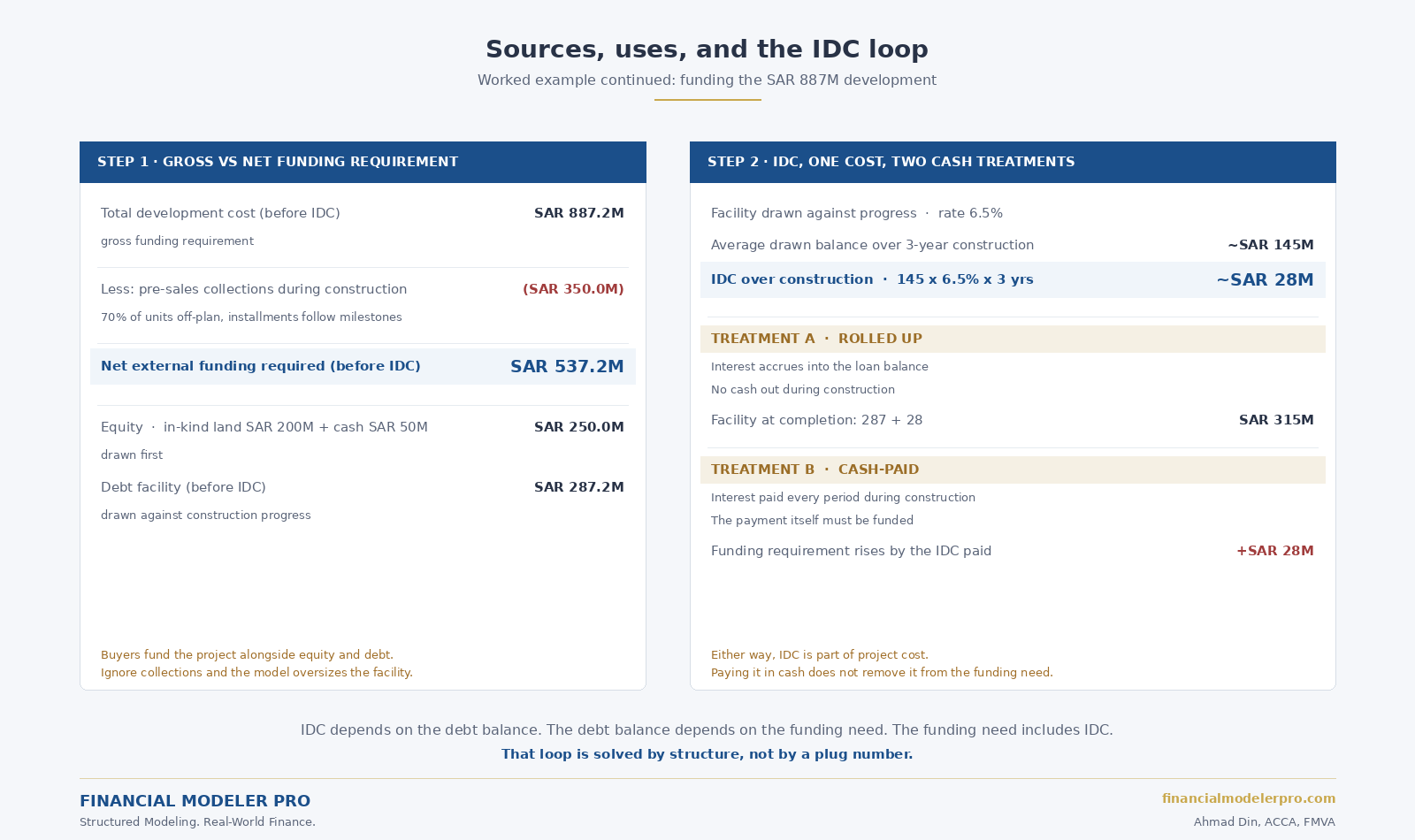
From the previous article: 70% of the residential units sell off-plan, on a payment plan whose installments follow construction milestones. Across the construction period, those collections total roughly SAR 350M. That cash arrives exactly when the project is spending, and in most KSA structures it is applied to construction through the escrow mechanism.
Net external funding required: SAR 887M minus SAR 350M = roughly SAR 537M before financing cost.
The difference matters enormously. A model that sizes the debt facility against gross cost, ignoring the collections curve, oversizes the facility, overstates the interest, understates the returns, and hands the lender a financing plan that does not match how the project will actually behave. The collections curve built in the previous article is not just a revenue schedule. It is a funding source, period by period.
The structure: equity, debt, and the drawdown order
With the net requirement established, the structure in our example:
- Equity: SAR 250M. Of which SAR 200M is the in-kind land contribution from the cost article, and SAR 50M is cash equity. Convention, and most facility agreements, put equity in first.
- Debt: roughly SAR 287M before financing cost, drawn against construction progress once equity is consumed.
The drawdown order is not cosmetic. Equity-first means the debt balance starts later and stays lower for longer, which directly reduces interest during construction. Pro-rata drawdown, where equity and debt fund each period side by side, raises the average debt balance and with it the IDC. Same project, same total sources, different interest cost. The model must implement whichever order the facility agreement actually specifies, because the difference flows straight into project cost and returns.
Repayment in a pre-sales structure typically comes from the handover collections, the 30% final installments, and from post-completion sales, which is why the debt in structures like this can be fully repaid shortly after delivery without needing a long operating tail.
IDC: one cost, two cash treatments
Interest during construction is the financing cost the project incurs before it earns. It is capitalized to project cost, it belongs in the feasibility, and it is the line where I have seen the most confusion in review sessions, including, recently, a full working session with a well-resourced review team on a live model before the structure spoke for itself.
The confusion is almost always the same: mixing up the accounting treatment with the cash treatment. They are separate questions.
Treatment A, rolled up. Interest accrues each period and is added to the loan balance. No cash leaves the project during construction. The facility grows: in our example, a SAR 287M facility at 6.5%, with an average drawn balance of roughly SAR 145M over a three-year build, accrues roughly SAR 28M of IDC, and the balance at completion is roughly SAR 315M.
Treatment B, cash-paid. Interest is paid in cash every period during construction. The loan balance does not grow. But here is the point that causes the arguments: the interest payment itself is a project cash outflow during a period when the project has no operating income. That payment must be funded, by equity, by additional drawdown, or by collections. The funding requirement rises by exactly the IDC paid.
Paying interest in cash does not make it cheaper and does not remove it from the funding need. It only changes where it shows up: in the loan balance under Treatment A, in the period cash flows under Treatment B. Either way it is part of the cost of the project, and either way the model must show it, drawdown by drawdown, charge by charge, payment by payment. That period-level visibility is what ended the debate on the recent model: when every interest charge and every funding movement is traceable, there is nothing left to argue about.
The loop: why IDC is circular, and how structure solves it
The final layer is the one that makes IDC genuinely technical rather than merely fiddly.
IDC depends on the debt balance. The debt balance depends on how much funding the project needs. And the funding need includes IDC. The calculation refers to itself.
In a spreadsheet this is the classic circular reference, handled with iterative calculation or an algebraic solve. The trap is the shortcut: a hardcoded IDC plug estimated once and never revisited. The plug is wrong the moment anything moves, a delay in the construction program, a change in the drawdown order, a faster sales curve, and it fails silently, because a hardcoded number does not announce that its assumptions expired.
A structured financing tab resolves the loop natively: the drawdown schedule, the interest calculation, and the funding requirement iterate to a consistent answer, and they re-iterate automatically when any driver changes. That is the difference between a financing plan and a financing guess.
What the financing tab must show
Pulling it together, the financing structure in a defensible model shows, period by period: the funding requirement net of collections, the equity drawdown, the debt drawdown against progress, the interest charge on the actual drawn balance, the treatment of that interest, rolled or paid, and the repayment path out of handover and post-completion collections. Every line traceable, every movement visible.
Next in this series: cost of sales matched to recognized revenue, and the operating assets, hotel and retail, whose revenue engines run on entirely different logic from the sales program.
Structuring the financing for a KSA development?
I take on selective advisory engagements for real estate developers, family offices, and investors across KSA and the GCC. Financing structures, lender packages, feasibility studies, and the period-level IDC discipline this article describes.